
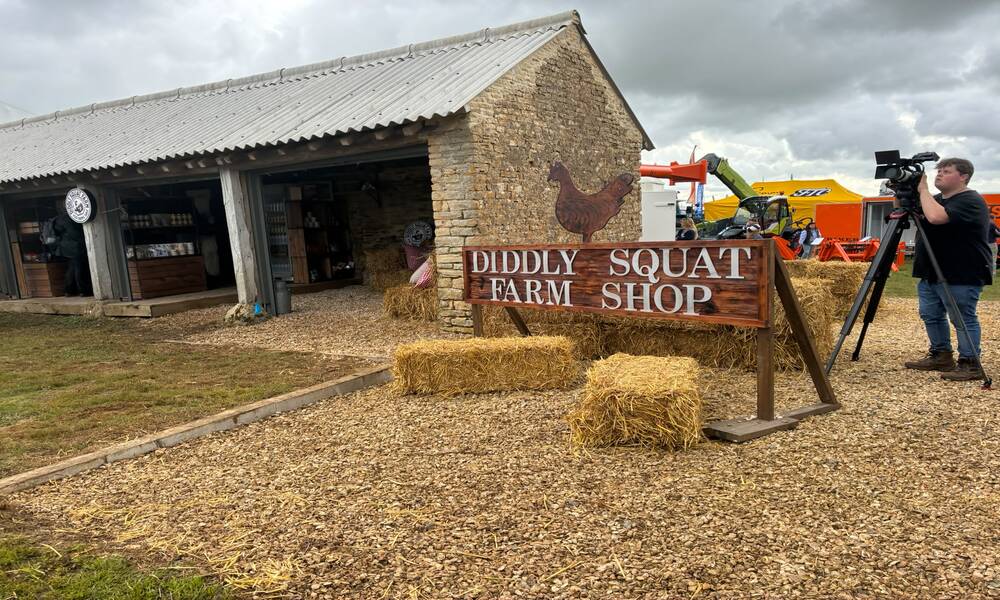
For most of the past decade, Cereals has been fighting a quiet battle to stay relevant. Attendance has drifted. The energy has softened. And, of course, Covid did to Cereals what it did to everything else, although the event certainly strengthened last year.
But this year, anticipation was high and the build-up to the event felt different. So the question I’m posing is this: If Cereals has bounced back, could it be the spark for something much bigger?
A very different kind of vibe
Make no mistake, Jeremy Clarkson’s involvement with Cereals looks like a masterstroke. Under normal circumstances, around 15,000 people attend the event over two days. This time, official numbers suggested it would be closer to 25,000, with 16,000 on day one alone. That’s an increase of over 60%. Whether that’s attributable to a genuine resurgence of interest in arable farming, or to the gravitational pull of a television personality with a few million followers on X, is a fair debate. It’s probably both. But what is interesting isn’t just how many people turned up, but who.
Clarkson farms beef, sheep and pigs alongside his arable operation. That makes him a genuinely mixed farmer. And, for me, that mix made me wonder in advance of the event whether Cereals – traditionally and firmly an arable event – might broaden its reach this year and widen its lens.
The answer was yes. Because Cereals 2026 introduced a dedicated Livestock Zone, reflecting growing demand from UK arable farmers seeking resilience and new income streams. In Kaleb Cooper’s words “All too often arable and livestock farmers have been separated by a fence. But if we’re serious about soil health and making farming last for the next 40 years, we’ve got to get animals back on the land.”
The ghost of the Royal Show
This is where it gets interesting. Because England once had exactly that kind of broad national agricultural show. The Royal Show at Stoneleigh drew over 130,000 visitors at its peak. It was open to the public, celebrated farming in all its forms, and sat at the centre of the agricultural calendar.
Of course, it collapsed. But it’s worth exploring why. I believe the honest answer is that it lost its way in both directions all at once. It became too urban and retail-focused for farmers – big flower tents, clothing stands, country fare – while simultaneously failing to offer the general public anything they couldn’t get at a county show closer to home. So it pleased nobody in particular and eventually pleased nobody at all!
But contrast that with, say, the Royal Welsh Show. It still draws 200,000 to 300,000 people to Builth Wells every year. It remains a genuine celebration of farming, not a dressed-up retail event. It has kept the balance right. The Highland Show does something similar. The lesson from both is that the formula can still work – it just has to be honest about what it is.
The case for something new
Agriculture has changed profoundly since the Royal Show folded. Specialisation drove the industry toward sector-specific events – Cereals for arable, dedicated shows for dairy, pig and poultry. That made sense at the time. But the sector is moving again. Regenerative agriculture, by its nature, means more mixed farming. Diversification is no longer a niche – around 80% of farms now have some form of income that isn’t straightforward food production. Renewables, fibre, environment, access, tourism: the modern farm is a land management business in the broadest sense.
Again, as Kaleb Cooper noted “All farmers are facing tough challenges and we need to spread the risk.”
So if farming itself is becoming more diverse and integrated, is it time for the events that represent it to follow suit? The question is genuine. And the RDP team that attended Cereals 2026 to experience the energy and mingle with its expanded audience will be feeding back on it soon. Watch this space.